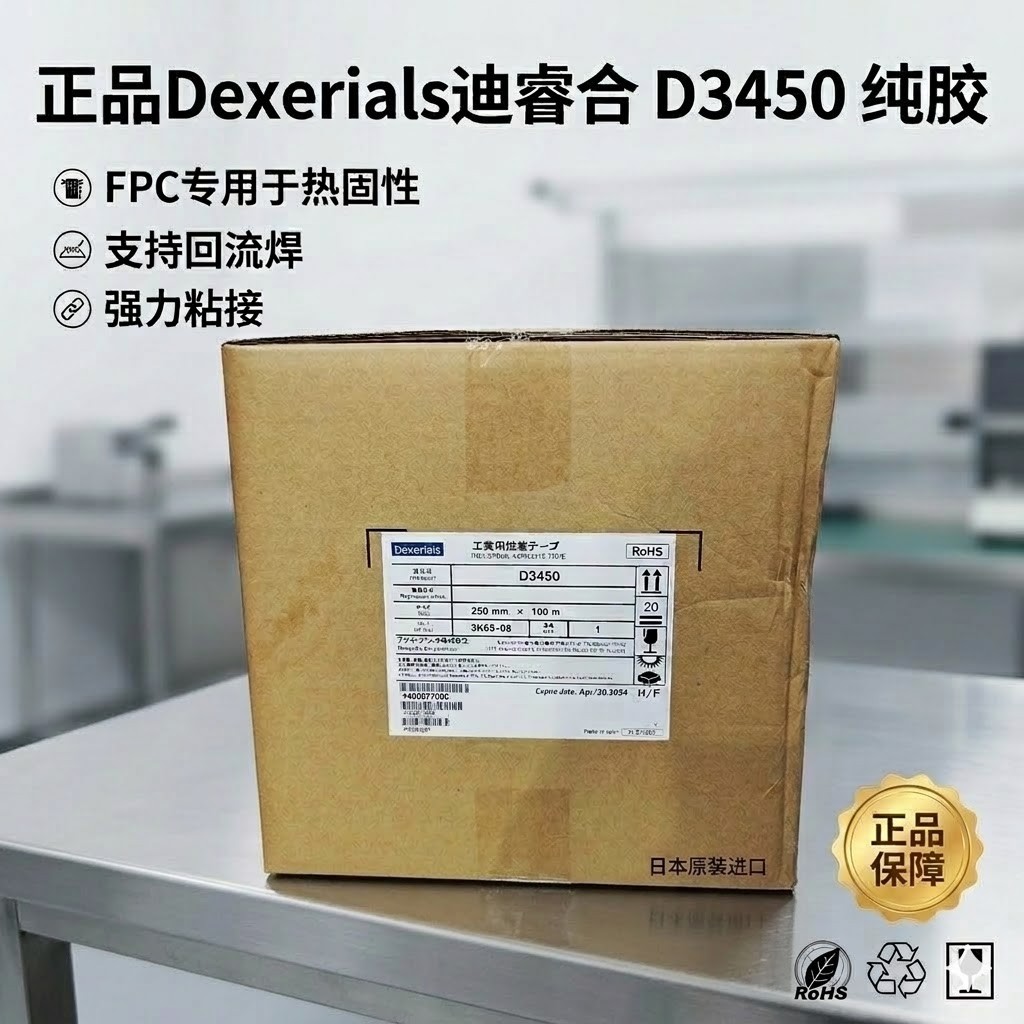
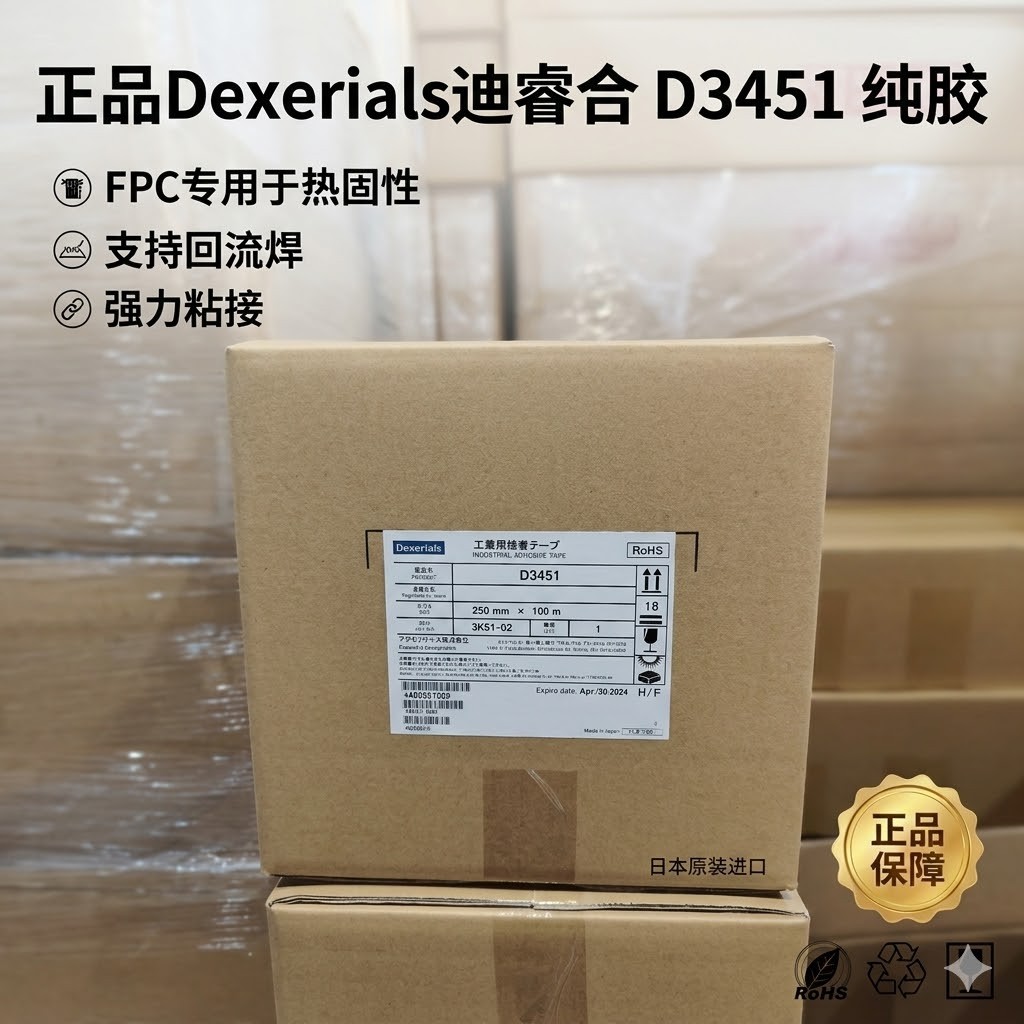
Dexerials D3450/D3451 special thermosetting adhesive film for FPC reinforcement board (thermosetting tape)
Product Overview
Dexerials D3450 series (including D3450, D3451) is a high-performance base-free heat-curing adhesive film specially developed for the bonding of flexible printed circuit boards (FPC) reinforcement boards.. This tape uses an acrylic/epoxy resin composite system. The initial adhesive layer has its own adhesiveness, making it easy to fit and pre-fix.。
This series of products is specially designed to withstand high-temperature lead-free reflow soldering processes. Even after lead-free reflow soldering (peak value 260°C) under hygroscopic and humid conditions, the appearance does not blister or delaminate, and the bonding force is durable and stable.. At the same time, it breaks through the limitation of traditional thermosetting adhesives requiring refrigeration, supports normal temperature storage, and is very suitable for vacuum quick press (Vacuum Quick Press) and traditional hot autoclave (Long Press) processes.。
Core advantages and features
Excellent resistance to lead-free reflow soldering:It has excellent resistance to moisture and heat delamination. After 96 hours of moisture absorption at 40°C × 90% RH, it remains unchanged (No change) through the lead-free reflow soldering process with a peak peak of 260°C.。
Breakthrough room temperature storage:It gets rid of the harsh conditions of traditional thermosetting tapes that must be stored at low temperature and refrigerated. It can be stored and transported at room temperature, greatly reducing warehousing management costs.。
Excellent initial tack, easy to position fake patches:The adhesive layer has good tack initially, and can be easily aligned before hot pressing to achieve temporary fixation (false bonding) of the base material to prevent misalignment.。
Extensive high-bond adhesion:It has extremely high bonding strength to common FPC reinforcing materials such as polyimide (PI film), FR-4 glass fiber epoxy board (Glass Epoxy), aluminum plate (Al) and stainless steel plate (SUS).。
Compatible with mainstream hot pressing processes:It is perfectly adapted to the efficient automation cycle of "vacuum rapid pressing + post-cure", and also supports the traditional long-cycle and long-pressure hot pressing process (Long Press)。
Product structure and specifications
Plaintext
[Structure diagram]
------------------------------- Release film (Release film, about 38 μm)
================== Adhesive layer (no base material)
------------------------------- Release paper (Release paper, about 130 μm)
| Specification items | D3450 | D3451 | Test instructions/notes |
| Main ingredients | Acrylic/Epoxy | Acrylic/Epoxy | Thermal curing composite resin |
| Substrate type | Non-carrier | Non-carrier | Pure film structure |
| Adhesive layer color | White | White | — |
| Glue layer thickness | approx. 35 μm | approx. 25 μm | Pure glue layer thickness |
| Release film thickness | approx. 38 μm | approx. 38 μm | protective film |
| Release paper thickness | About 130 μm | About 130 μm | Backing release paper |
| Standard bonding strength | 31 N/10mm | 25 N/10mm | CCL/PI reinforcement sheet (90° peeling) |
| Standard roll size | 250mm × 100m / 500mm × 100m | 250mm × 100m / 500mm × 100m | Support customized slitting |
Technical performance data
1. 90° peel strength test of various reinforcing substrates (adhered surface: CCL copper clad laminate, speed 50mm/min)
Vacuum Quick Press + Postcure process (Vacuum Quick Press + Postcure):
CCL/Polyimide:D3450 is31 N/10mm(Maintain 31 N/10mm after reflow soldering);D3451 is25 N/10mm(Maintain 25 N/10mm after reflow soldering)
CCL/Glass Epoxy:D3450 is27 N/10mm(raised to 28 N/10mm after reflow soldering);D3451 is23 N/10mm
CCL / stainless steel plate (SUS):D3450 is17 N/10mm(18 N/10mm after reflow soldering);D3451 is16 N/10mm
CCL/Aluminum:D3450 is16 N/10mm;D3451 is15 N/10mm
Long Press process:
CCL/Polyimide:D3450 is 26 N/10mm;D3451 is 21 N/10mm
CCL/Glass Epoxy:D3450 is 28 N/10mm;D3451 is 22 N/10mm
CCL / stainless steel plate (SUS):D3450 is 18 N/10mm;D3451 is 16 N/10mm
CCL/Aluminum:D3450 is 16 N/10mm;D3451 is 15 N/10mm
2. Reflow soldering heat resistance verification (peak temperature 260℃)
Drying treatment, pre-baking pre-treatment (100℃ × 1h):The appearance after reflow soldering does not have any delamination or blistering (No change)。
Severe moisture absorption pretreatment (40℃ × 90% RH × 96h):After reflow soldering, the appearance is still intact, no bubbles and no degumming (No change)。
Typical application scenarios
FPC (flexible circuit board) reinforcement board bonding and fixation:
Polyimide film (PI reinforcement sheet) lamination
FR-4 / Glass Epoxy Stiffener lamination
Metal stainless steel sheet (SUS Stiffener) fit
Aluminum Stiffener and other heat sink/support sheet lamination
Precision flexible boards, camera modules, display touch modules and battery flexible board assemblies that need to undergo SMT lead-free reflow high-temperature processes。
Recommended hot press curing process conditions
Condition A: Vacuum rapid pressing + post-curing (recommended process, high production efficiency)
Vacuum rapid compression stage:
Hot pressing temperature: 160 ~ 180 ℃
Vacuuming time: 10 ~ 30 seconds
Hot pressing time: 1 ~ 2 minutes
Hot pressing pressure: 1 ~ 2 MPa
Post-curing stage (oven):
condition:140 ℃ × 60 minutes
Condition B: Ordinary long press process (Long Press)
Hot pressing temperature: 160 ℃
Holding time: 60 minutes
Hot pressing pressure: 3 MPa
Precautions for engineering use
Glue overflow control:The hot-melt flow characteristics of the adhesive film are closely related to the material thickness, size and stamping shape of the reinforcing plate; for the lamination of reinforcing plates with openings and hollows, the amount of hot-pressed glue overflow needs to be evaluated in advance。
Residual bubble avoidance:When laminating large-sized and large-area reinforcing sheets, microbubbles are easily involved in the hot pressing process; it is recommended to fully evaluate the laminating and vacuuming process before using it on a large area to prevent bubbles from remaining.。
Environmental adaptation:The actual lamination parameters need to be combined with the customer's actual equipment thermal conductivity rate and substrate material for proofing and fine-tuning verification.。